So, what in the stablecoin is USDT?
A few months ago, I got an offer letter from a global company. It was my first win of the quarter, and I was already dreaming of the celebration jollof… until I saw it:
“Your gross monthly salary will be 1,000 USDT.”
US… what now?
I squinted. Tilted my head. Refreshed the email.
USDT?
Was that a typo? Who slaps a T behind USD? That’s not even how alphabets work. My inner HR rep almost popped out: “Please, let’s be guided.”
I messaged the hiring manager (with a bit of “aunty energy”) to flag the ‘error.’
They replied:
“Not a typo. We pay in USDT.”
Cue mental spiral:
Is this a rebranded currency?
Is the United States doing something they didn’t tell the rest of us?
Or… am I old?
Thankfully, my all-knowing friend Ebun stepped in before I deep-dived into Google.
“USDT is a stablecoin. It’s kind of like a way to step into crypto without the wahala of prices rising and crashing.”
She continued:
“Think of it as a digital asset that’s pegged to the dollar. It won’t jump like Bitcoin, and it won’t crash overnight. You’re getting the benefits of crypto without the fear factor.”
Hmm. So it’s like a calm middle ground? Not exactly cash. Not exactly Bitcoin. Just… stable?
That’s when I truly started researching stablecoins.
So, What Are Stablecoins, Really?
Think of stablecoins as the calm cousins in the crypto family.
While Bitcoin and Ethereum are doing backflips with price swings, stablecoins sit quietly in the corner drinking zobo.
They are digital assets (not currencies!) designed to stay… well, stable.
They’re usually tied to a real-world asset like the US dollar, euro, or gold.
That means 1 USDT ≈ 1 USD (or close).
This makes them perfect for:
✅ People who want to try crypto without the rollercoaster
✅ Cross-border value storage without touching volatile coins
✅ Fintech apps that want to integrate low-volatility assets
✅ Digital-first payroll or reward systems
✅ Saving in crypto without sweating through your shirt
“But Is It Real Money?”
Let’s be clear:
We’re not saying stablecoins are a replacement for your local currency.
This is not about trading naira for a new national tender.
Stablecoins are simply a more predictable entry point into the world of digital assets.
If you’re crypto-curious but volatility-wary, stablecoins like USDT are your training wheels.
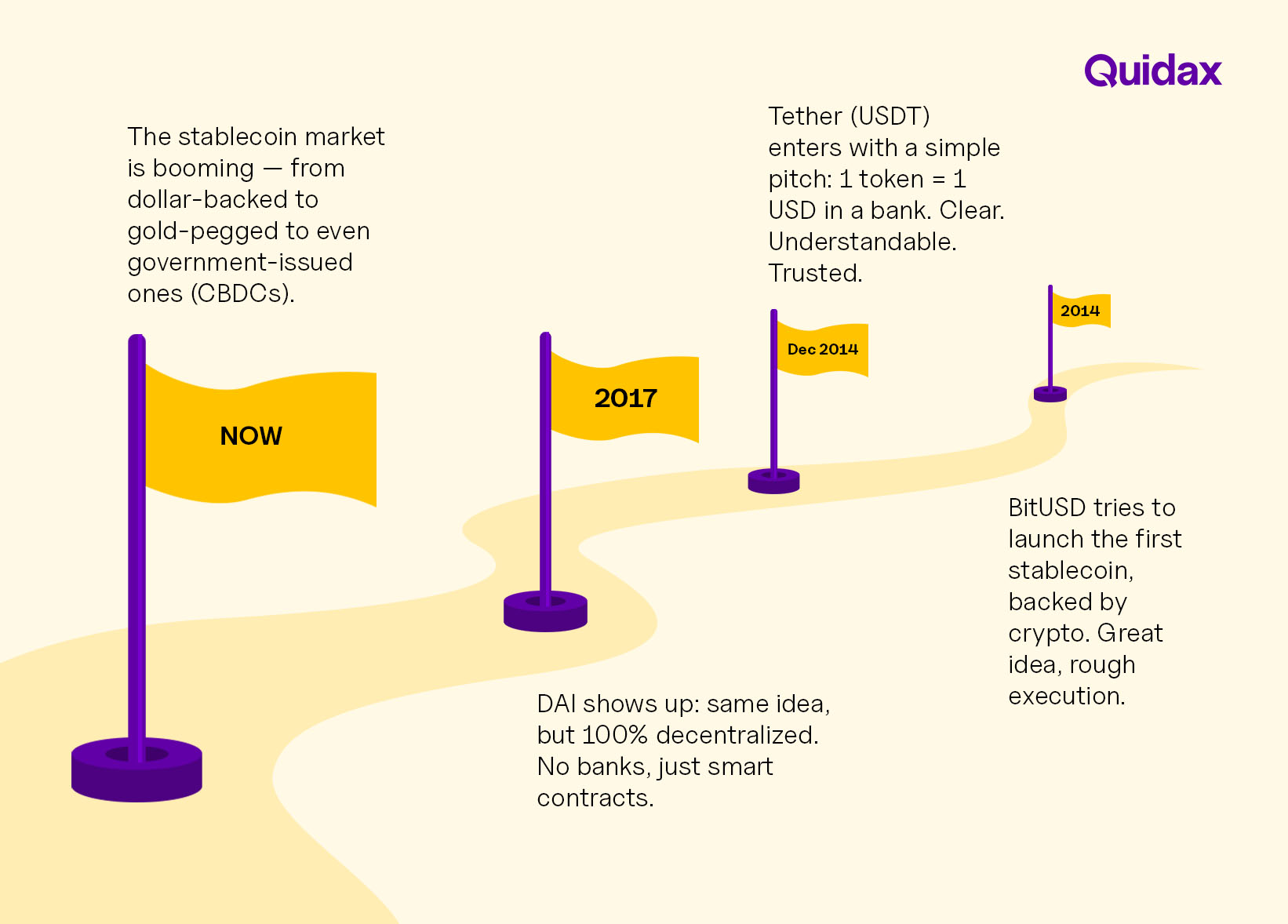
A Brief History
Wait, What’s a Smart Contract?
Think of it like a digital vending machine.
You insert money, press a button, and it does what it’s coded to do, no human needed.
In crypto, a smart contract is code that says:
“If X happens, then do Y.”
No middlemen. No trust issues. Just automation.
DAI and other crypto-backed stablecoins use smart contracts to keep things… well, stable.
Popular Types of Stablecoins
| Type | How It Works | Example | Tradeoff |
| Fiat-backed | $1 in a bank for every token issued | USDT, USDC | Requires trust in issuers |
| Crypto-backed | Collateralised with other crypto | DAI | Needs overcollateralisation |
| Algorithmic | Adjusts supply/demand via code | (RIP) UST | Risky — can depeg quickly |
Why Should Fintechs, Banks & Startups Care?
Because stablecoins offer a low-risk bridge into digital assets, one that:
💸 Makes cross-border value transfers easier
📲 Can be integrated into fintech platforms via APIs
🚀 Powers crypto-based rewards, savings & payroll options
🛡️ Reduces user exposure to high-volatility assets
🌍 Works well in ecosystems with growing developer and user bases
Stablecoins vs. Bitcoin & Ethereum
| Crypto Type | Feels Like | Great For | Not Ideal For |
| BTC / ETH | Rollercoaster | Investing, long-term holding | Everyday use, short-term saving |
| Stablecoins | Smooth train | Payments, savings, testing crypto | Big returns, speculation |
So, What’s the Point?
Stablecoins aren’t trying to replace local currencies. They’re not fighting your bank app.
They’re here to give you and your users a steady, low-barrier gateway into the digital economy without the stress of watching your money nosedive overnight.
They’re the option for:
✅ First-time crypto explorers
✅ Developers testing blockchain integrations
✅ Startups exploring on-chain finance
✅ Fintechs adding digital assets without rocking compliance boats
What’s Next?
In Part 2 of this series, we’ll explore how retail businesses and global merchants especially in crypto-forward markets are experimenting with stablecoins like USDT and cNGN to store value, and simplify cross-border transactions. Some local businesses are already recognizing the utility of these digital assets not for everyday payments, but as a way to preserve earnings in more stable climes.
Until then, if you ever see “USDT” again in an offer letter, just smile, open your wallet app…
and tell your inner HR auntie to calm down, you’ve got this.